R2 Website Relaunch and SIPS Mission Award
Website Relaunch Today, we are relaunching our journal website with a revised design and several features to further increase the levels of transparency and accessibility. “Under…

Diamond Open Access · ISSN 3052-5977

Replication Research is a diamond open-access and researcher-led journal.
We publish reproductions, replications, and conceptual articles concerned with repeatability.
Multi-study articles
Editorial Communication

All journal materials (e.g., constitution, submission guidelines) as well as supporting materials (e.g., open peer review reports, our replication handbook) are published in the Zenodo community.

The following articles have been submitted and are currently undergoing peer review or reproducibility checks. Get in touch at contact@replicationresearch.org if you want to join review so that we can plan accordingly. You can do so via our system or via PREreview.org.
With authors (pre review revision)
Abstract
The present study aimed to directly replicate the seminal findings of Decety et al. (1989), while also extending the original work with a larger sample size and additional statistical analyses.
Thirty healthy adults completed both imagined and executed walking tasks over distances of 5, 10, and 15 meters. Participants also completed the Movement Imagery Questionnaire-3 (MIQ- 3). Temporal correspondence between imagined and executed walking was assessed using repeated-measures ANOVA, correlation analyses, Bayesian equivalence tests, and Bland– Altman analyses.
Walking duration increased significantly with distance, while no significant differences were observed between imagined and executed walking times. Bayesian equivalence tests provided evidence supporting temporal equivalence between the two modalities, and Bland–Altman analyses indicated good agreement with minimal systematic bias. Strong positive correlations were found between imagined and executed durations at all distances. MIQ-3 scores were not significantly associated with differences between imagined and executed walking durations.
Overall, the findings successfully replicate and extend the original results reported by Decety et al. (1989), providing additional evidence supporting temporal equivalence between motor imagery and movement execution. By combining a larger sample size with contemporary statistical approaches, the present study strengthens support for the principle of functional equivalence for highly automated and cyclic movements.
Inviting Reviewers
In two experiments, Eitam, Hassin, and Schul (2008) found evidence that priming of nonconscious goal pursuit could extend beyond reproductions of past associations and facilitate novel learning, specifically implicit learning. Given the implications of such findings and dearth of subsequent investigations of this phenomenon, we conducted a direct replication of their second experiment using materials graciously shared by the original authors. Despite using a sample size that provided .80 power to detect the original effect size, we failed to find evidence that priming of nonconscious goal pursuit facilitated implicit learning. Our replication was conducted as part of the Reproducibility Project: Psychology (Open Science Collaboration, 2015) and study preregistration, materials, and data are available online (https://osf.io/edcr7).
Copy-Editing
Preprint Write review Read reviews
We conducted a direct replication of Irving et al. (2022) examining whether a debunking statement reduces mistaken causal inferences from correlational evidence. We randomly allocated participants to read a news article containing either a correction statement (n = 65) or a no-correction control (n = 64). Participants in the correction group made fewer causal inferences (delta = 0.65, 95% HDI [0.30, 1.00]) and more correlational inferences (delta = 0.72, 95% HDI [0.36, 1.07]) compared to the no correction group. In exploratory analyses, we also supported the robustness of their findings to alternative modelling choices. Our findings represent a successful direct replication of Irving et al.
Will we interpret a correlation correctly if we know about the "correlation is not causation" fallacy? This paper replicated a previous finding where a statement on top of a publication informed people about a wrong causal framing (X causes Y) in the study reporting a correlation (X and Y are related). The earlier authors found that when people read such a correction, they more often correctly interpreted correlations as an association and not as a causal finding. This study was able to replicate this result, also additionally showed that the finding holds even when changing small things about the analysis.
With authors (1st revision)
Preprint Write review Read reviews
Foxworth et al. (2022) examine the influence of partisanship, along with socio-economic factors, on the spread of COVID-19 among Native American tribes and conclude that tribes in states with Republican governors and where Trump received more votes in the 2016 election fared worse. While their argument and findings sound plausible, the study is flawed methodologically. The most significant issue is that the analysis focuses on the count of cases while not accounting adequately for vast differences in the population of the tribes. Re-analyze the data, I demonstrate that partisanship does appear to be correlated with the spread of COVID-19, but the magnitude of the effect is an order of magnitude smaller than that implied by Foxworth et al.’s (2022) analysis. However, the large proportion of tribes that register no COVID cases casts doubts on those findings, as it is unclear whether these represent the actual absence of COVID or issues with the data collection.
With authors (1st revision)
Preprint Write review Read reviews
Labels are often advantageous for category learning. However, this may not be true for children as they learn subordinate, fine-grained object categories. In preparation for future research on subordinate category learning in children, we aimed to refine a procedure investigating the label advantage during subordinate category learning in adults. Thus, we conducted an online replication of Experiment 2 from Lupyan, Rakison, & McClelland (2007), which compares category learning under an auditory or written label condition versus a no label and non-linguistic cue condition in adults. We failed to replicate the key result, that those who received labels learned the categories faster.
With authors (1st revision)
Preprint Write review Read reviews
Replication studies play an important role in scientific knowledge generation, but researchers lack a coherent account of how to conclude whether a finding has been replicated. This paper provides such an account by connecting methodological falsificationism and the Neyman-Pearson approach to statistical inferences in the context of the analysis of replication studies. From this perspective, the goal of a replication study is to examine whether the same basic statement that was made in an original study can also be made when new data are collected in a faithful empirical realization of the original test. If the original study made an ordinal claim based on a statistical decision rule, the replication study should evaluate whether the same claim can be made using the same inferential criterion. We argue that the original effect size estimate should also be treated as part of the original claim, and therefore that replication studies should additionally examine whether the effect size differs meaningfully from the original estimate. We illustrate how such comparisons can be performed for correlations by using equivalence tests and point out the importance of reflecting on which difference between replication studies is large enough to matter. More broadly, we argue that researchers should choose an analysis strategy for replication studies where their philosophy of science and statistical framework are coherently aligned.
With authors (1st revision)
This replication study critically examines the findings and conclusions of Forster and Neugebauer (2024), who question the external validity of factorial surveys in capturing real-world behavior. Using the publicly available data from the original study, we reassess the effects of educational signals and ethnic origin. Our analyses show that the original results do not withstand all robustness checks and that theoretically derived effect heterogeneities across occupational fields provide more nuanced explanations. These findings challenge the general claim that factorial surveys are unsuitable for studying hiring processes and instead underscore the importance of context-sensitive modeling. We argue that factorial surveys remain a valuable methodological tool, particularly when heterogeneity is explicitly addressed in both design and analysis.
With author (Pre-Review revision)
Bol and van de Werfhorst’s article published in 2013 represents a milestone for researchers studying the effect of educational institutions on micro-level outcomes. In the above-mentioned article, tracking and other concepts, like vocational enrolment and vocational specificity, have been operationalized into numerical indicators and then used in regression models in order to establish their associations with individual outcomes. This article points out that Bol and van de Werfhorst’s analyses contain two errors. First, their model specifications disregard the role played by a confounder i.e., political orientation of policy makers. Second, their analytical strategy does not adequately correct for the fact that the dependent variables are estimated from external data. I replicate their analyses regarding social inequality of educational attainment (OE) and educational gradient in occupational attainment (ED) correcting for both errors. These new findings do not support the existence of a trade-off between labour market allocation and equality of educational opportunity when it comes to educational and occupational attainment.
With reviewer (3rd round)
Preprint Write review Read reviews
The evidential link between Relational Frame Theory (RFT) and Acceptance and Commitment Therapy (ACT) is a matter of on-going debate. Foody et al. (2013) is frequently cited as evidence for ACT’s concept of Self-as-Context and as evidence for the ties between ACT’s middle level clinical terms and the more basic account of language and cognition provided by RFT. However, the failed replication study by Foody et al. (2015) typically goes uncited. Given their importance, I critically re-evaluate the results of both articles. I found several issues, the most important of which was that the central claim does not correspond with the reported analyses. When I extracted summary statistics from both studies and used them to conducte a multiverse analysis, that mapped directly onto the original claim (i.e., that the hierarchy condition reduced distress more than the distinction condition), null results were found under every set of conditions. Taken together, results illustrate how weak or flawed research practices and uncritical citation of results can hinder cumulative science and evidence based clinical practice.
This paper examines whether a well-known therapy, Acceptance and Commitment Therapy (ACT), is truly supported by a theory about how people think and use language. An earlier study is often cited as strong evidence for this link, but a later study that tried to repeat the findings and didn’t get the same results is often overlooked. The author took a look at both studies and found that the main conclusion of the original study doesn’t seem to match what the data actually show. Then, the author used a “multiverse analysis” to explore all the different choices researchers could make when analyzing results. Across all of these choices, the same result appeared every time: there was no clear evidence supporting the original claim.
With author (1st revision)
Preprint Write review Read reviews
Abstract
The decoy effect occurs when adding an inferior third option biases choice between two others, even though the decoy is rarely chosen. While robust in value-based decisions, evidence in perceptual tasks is mixed. Using the rhesus-macaque paradigm from Parrish et al. (2015), we tested whether a perceptual decoy effect generalizes to humans. Participants ( n = 50) completed 400 trials. Contrary to our preregistered prediction, we found no reliable decoy effect. Accuracy improved on the hardest trials (Level 1) when a decoy was present, response times were slower in decoy conditions than baseline, and accuracy was higher for tall versus wide rectangles, consistent with the vertical–horizontal asymmetry. The relatively wide spacing of stimuli may have reduced grouping and attentional clustering; because spacing was not manipulated, this remains a hypothesis for future tests. Results suggest that context effects in perceptual choice operate under narrower boundary conditions than in value-based domains.
Replication Research is a Diamond Open Access Journal with strict and entirely transparent quality control and no article processing charges. We publish close and conceptual replications as well as reproductions.
Replications, that is the repeated testing of previously published claims, should be the foundation for cumulative and quantitative science but they are not. We are here to change this. If you seek to publish replication research such as reproductions (same data) or replications (different data) with rigorous and transparent quality assurance (open and persistent peer review, reproducibility check) in an open and accessible way, we are here for you.
Due to replication research gaining momentum across fields such as economics, psychology, biostatistics, earth science, humanities, and medicine, new methods to conduct and assess replications are being developed. Currently, researchers work in parallel and thus do double work. Replication Research is a place where expertise from different fields comes together in form of theory papers to shape the gold standard for transdisciplinary replication research.
Replication Research is hosted by the University of Münster and maintained by the Münster Center for Open Science (MüCOS) and the Framework for Open and Reproducible Research Training (FORRT).
Website Relaunch Today, we are relaunching our journal website with a revised design and several features to further increase the levels of transparency and accessibility. “Under…
Eight Months In: A Round-Up of Recent Developments Replication Research (R2) continues to grow, and we're pleased to share several updates from the past few weeks. First peer…
We have several exciting updates and new initiatives to share with the Replication Research community as we continue our mission to support and publish high-quality replication…
 Replication Journal Federation
A federation of journals championing replication research together.
Replication Journal Federation
A federation of journals championing replication research together.
 FLoRA Explorer
Browse FORRT's Library of Reproduction and Replication Attempts.
FLoRA Explorer
Browse FORRT's Library of Reproduction and Replication Attempts.
 Handbook for Reproduction and Replication Studies
Practical, field-tested guidance for planning and conducting replication work.
Handbook for Reproduction and Replication Studies
Practical, field-tested guidance for planning and conducting replication work.
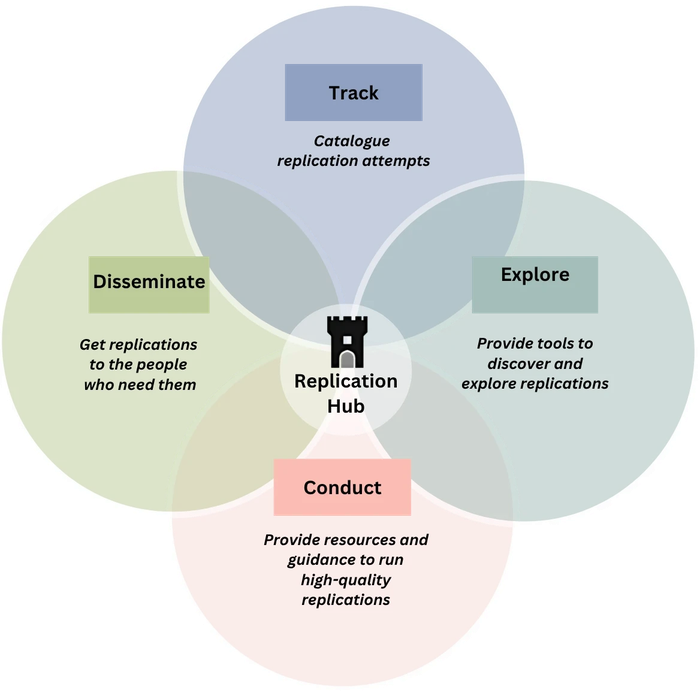 FORRT Replication Hub
Track, explore, disseminate, and conduct replications in one place.
FORRT Replication Hub
Track, explore, disseminate, and conduct replications in one place.
 Zotero Replication Checker
A Zotero plugin that flags whether a reference in your library has been replicated.
Zotero Replication Checker
A Zotero plugin that flags whether a reference in your library has been replicated.
 Love Replications Week
An annual celebration of replication research, with events and showcases across the community.
Love Replications Week
An annual celebration of replication research, with events and showcases across the community.
 Guess the Replication
A quiz game that tests your intuitions about which studies replicate.
Guess the Replication
A quiz game that tests your intuitions about which studies replicate.
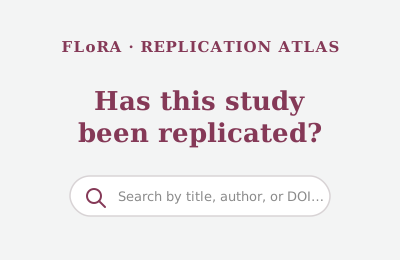 Replication Atlas
Search any study to see whether it has been replicated, powered by FORRT's FLoRA database.
Replication Atlas
Search any study to see whether it has been replicated, powered by FORRT's FLoRA database.